Why One Weak Series Group Limits Your Entire Battery Pack
How capacity matching can improve usable battery capacity without adding more cells.
When assembling a lithium battery pack from used cells, it is tempting to focus on the total capacity of all available cells. However, in a series-connected battery, total cell capacity is not the only factor determining how much energy the pack can deliver.
A single weak series group can limit the usable capacity of the entire battery. This is especially important when reusing lithium cells with different capacities due to aging and different operating histories. The challenge is to distribute them into parallel groups whose capacities are closely matched.
1. Why the Weakest Series Group Matters
Consider a 14S4P battery: 14 groups connected in series, each containing four cells connected in parallel, for 56 cells in total.
Within each parallel group, cell capacities contribute to the group's total capacity. All 14 series-connected groups, however, carry the same current. If one group has less usable capacity, it may reach its discharge-voltage limit first. The battery management system (BMS) must then protect the pack even though stronger groups may retain unused capacity.
This is why capacity matching matters.
2. A Practical Experiment with 56 Lithium Cells
We created a synthetic dataset of 56 hypothetical used lithium cells with different capacity values. The same dataset was used in two assembly scenarios.
| Dataset parameter | Value |
|---|---|
| Number of cells | 56 |
| Individual capacity range | 8.441–11.349 Ah |
| Total cell capacity | 559.693 Ah |
| Target configuration | 14S4P |
| Mean parallel-group capacity | 39.978 Ah |
Scenario A: Cells were assigned in their original CSV order to consecutive groups of four, without capacity optimization.
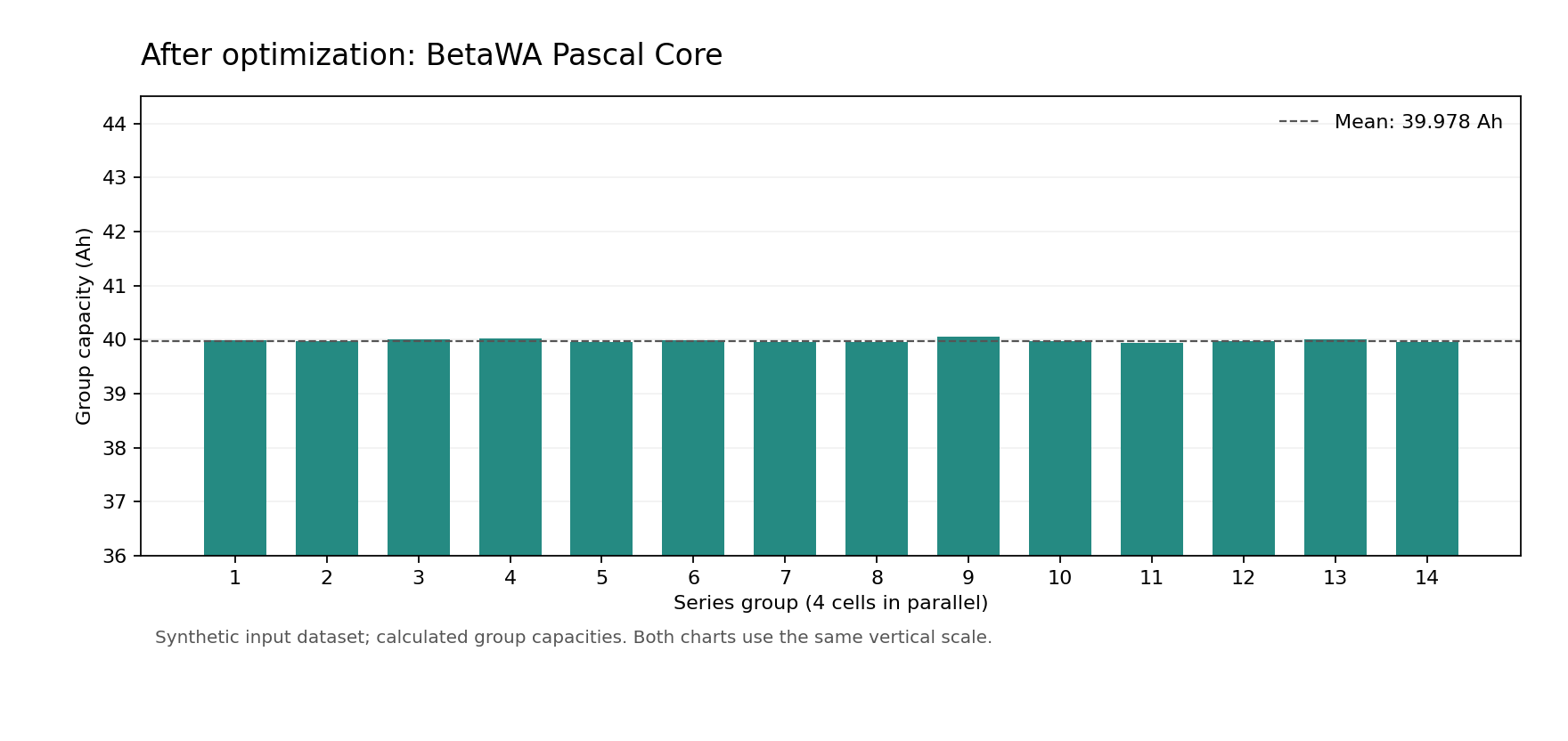
Scenario B: The same cells were redistributed by the BetaWA Pascal Core engine. No cells were added or removed.
3. Scenario A: Without Capacity Optimization
When the 56 cells were divided into 14 consecutive groups of four, group capacities varied considerably:
| Parameter | Result |
|---|---|
| Minimum group capacity | 37.744 Ah |
| Maximum group capacity | 43.376 Ah |
| Mean group capacity | 39.978 Ah |
| Capacity spread | 14.0877% |
Capacity spread (%) = (Maximum − Minimum) / Mean × 100
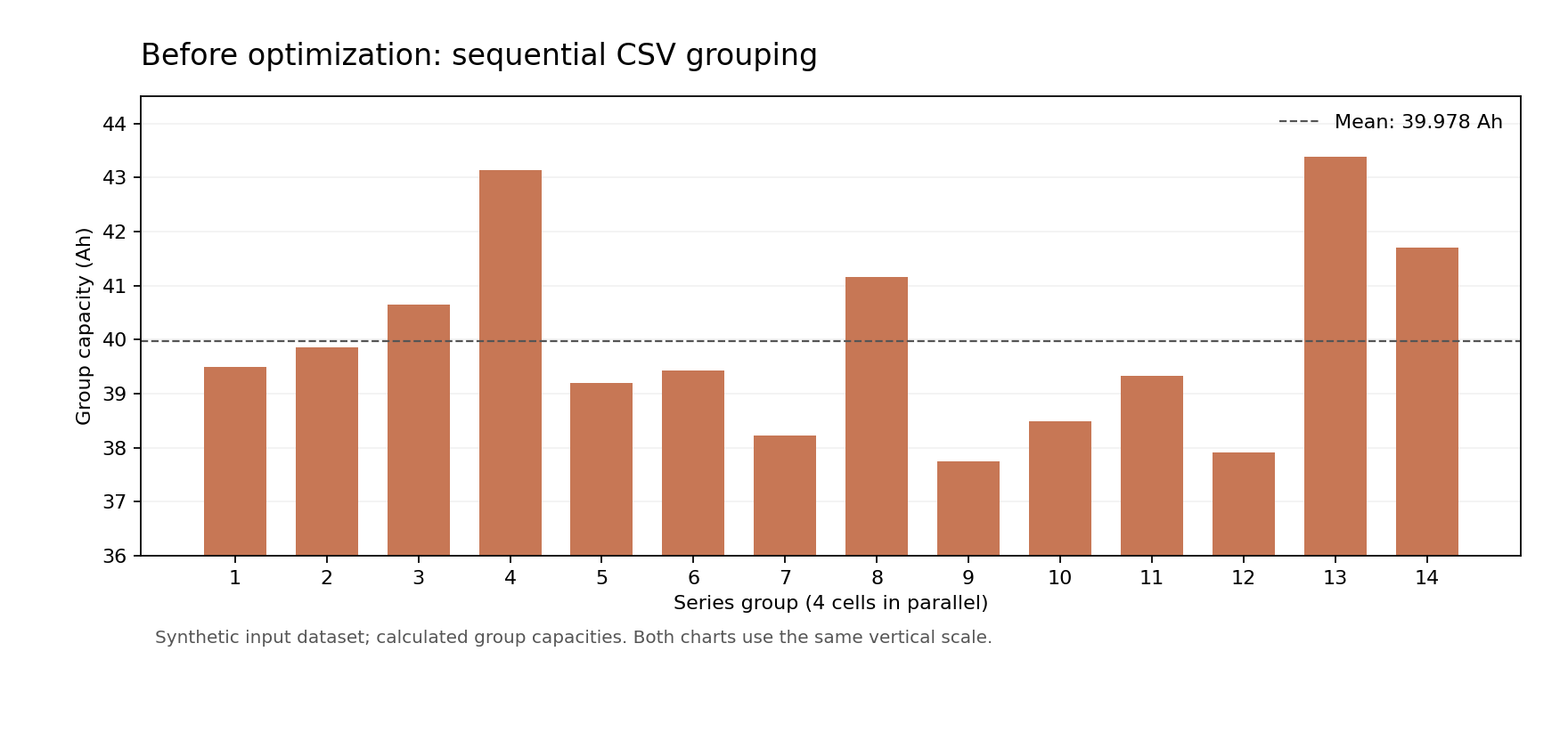
Although the mean group capacity was close to 40 Ah, the weakest group contained only 37.744 Ah. In a simplified weakest-group model, this would limit the usable discharge capacity of the series-connected pack.
4. Scenario B: Capacity Matching with BetaWA
Next, the same 56 cells were processed by the BetaWA Pascal Core optimization engine for a 14S4P configuration. It produced one complete battery, using all 56 cells.
| Parameter | Result |
|---|---|
| Minimum group capacity | 39.944 Ah |
| Maximum group capacity | 40.047 Ah |
| Mean group capacity | 39.978 Ah |
| Achieved capacity spread | 0.2576% |
| Cells used / unused | 56 / 0 |
5. How Much Usable Capacity Was Recovered?
The weakest group increased from 37.744 Ah to 39.944 Ah — a difference of 2.200 Ah.
(39.944 − 37.744) / 37.744 × 100 ≈ 5.83%
Under the simplified weakest-group capacity model, this is approximately 5.83% more usable battery capacity in Ah from the same 56 cells. The capacity spread decreased from 14.0877% to 0.2576% — about a 54.7-fold reduction.
| Metric | Before BetaWA | After BetaWA |
|---|---|---|
| Minimum group capacity | 37.744 Ah | 39.944 Ah |
| Maximum group capacity | 43.376 Ah | 40.047 Ah |
| Capacity spread | 14.0877% | 0.2576% |
| Estimated weakest-group-limited capacity | 37.744 Ah | 39.944 Ah |
6. Why Perfect Matching Is Not Always Possible
Matching quality depends on the available capacity distribution, the number of cells, the chosen parallel-group size, the number of series groups, and the requested tolerance. An algorithm cannot guarantee a target tolerance for every inventory. Reporting the achieved spread is therefore more informative than assuming the requested value was reached.
7. Capacity Matching Is Only One Part of Battery Safety
Used lithium cells also require assessment of internal resistance, self-discharge, chemistry compatibility, voltage behavior under load, physical condition, thermal performance, and appropriate BMS and protection design. Parallel connection requires suitable voltage matching and electrical engineering controls.
BetaWA Simple Mode optimizes measured capacity grouping; it does not certify cell health, electrical compatibility, or battery-pack safety. Battery assembly and testing should be performed by qualified personnel using appropriate safeguards.
8. Try the Same Dataset with BetaWA
Download the synthetic 56-cell CSV and run the 14S4P calculation in BetaWA. Select one battery and request a 0.20% tolerance. Optimization results may vary with engine version and search settings.
Conclusion
Series-connected batteries can be limited by differences between their parallel groups. In this demonstration, capacity matching increased the weakest group's capacity from 37.744 Ah to 39.944 Ah without adding cells.
Better cell distribution cannot restore lost cell capacity, but it can help make more effective use of the capacity that remains.